Department of VRAR Applied Content

- Departments
- Graduate School of Welfare Management
- Department of VRAR Applied Content

- NameSuh Donghee
- Phone041-580-5352
- Phone041-580-5350
- Fax000-000-0000
- Websitehttps://vrar.nsu.ac.kr/
Introduction
In the era of the Fourth Industrial Revolution, Virtual Reality (VR) and Augmented Reality (AR) technologies are gaining attention. With the recent pandemic situation and the commercialization of 5G, technological development is spreading rapidly beyond our expectations.
XR technology, also known as Extended Reality, creates new forms of extended reality by freely combining or separately applying VR and AR technologies.
Therefore, this department aims to conduct research and development through the creative convergence of knowledge and technology, and to cultivate highly specialized professionals in VR and AR required in the Fourth Industrial Revolution era through an online program.
Educational Objectives
- Cultivating VRAR applied content professionals who can lead virtual worlds and future society.
- Cultivating convergence-oriented professionals who practice creative thinking.
- Cultivating convergence technology professionals who can apply advanced technologies of the Fourth Industrial Revolution.
- Cultivating progressive convergence professionals with a global mindset.
- The program aims to strengthen competitiveness in the era of the Fourth Industrial Revolution by nurturing professionals with solid fundamentals, convergence technology expertise, and global perspectives.
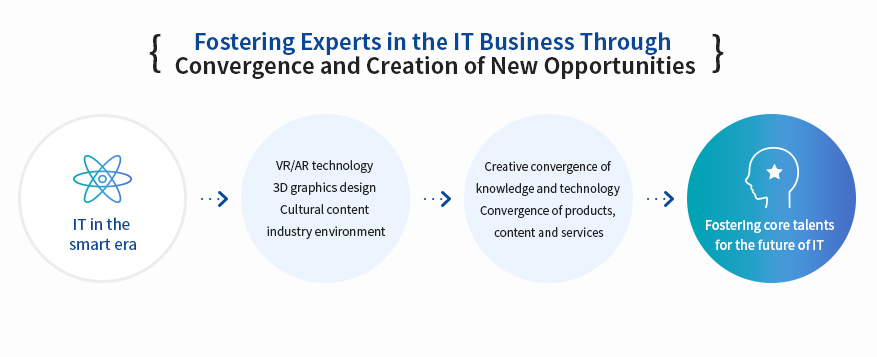
Educational Characteristics
- Convergence and Deepening
- The master’s program in VRAR Applied Contents systematically organizes the curriculum into Research, Planning, Development, Design, and Production in order to cultivate VRAR content professionals.
- Systematic Online Education
- To differentiate online education, the program develops specialized teaching methods through collaboration with professors from each field and industry professionals, and provides online lectures and educational programs that improve completion and graduation rates.
- Practice-Oriented Technical Education
- The program operates systematic courses that include theory, discussion, and practice, and connects various VR/AR-related projects through industry-academic cooperation projects.
- The ratio of practical courses to theoretical courses is 2:1, with an emphasis on hands-on practice.
- Through four semesters, from the first semester of the first year to the second semester of the second year, students receive education starting from basic concepts and fundamental technical skills to professional technical skills, project execution abilities, and research capabilities. - Cultivation of Global Talent
- Through project-based research exchanges and cooperation with research-oriented universities and research institutes in Korea and abroad, the program cultivates global talent and helps students grow into an internationally competitive graduate school.
- Experience in Online Master’s Programs for VR Professionals Targeting World Bank and OECS Countries
- With support from the World Bank, Namseoul University supports graduate degree programs for training VR professionals for countries in the Organization of Eastern Caribbean States (OECS).
Features and Strengths
- The department has showrooms and various VR/AR devices that allow students to experience a wide range of VR/AR content.
- Students publish papers in Korea’s leading academic journals and receive excellent research awards.
- Students submit their works to various VR/AR-related exhibitions and have received multiple awards.
Career Paths After Graduation
- VR/AR content planner
- VR/AR content developer
- Graphic designer
- UI/UX designer
- Immersive content producer
- VR/AR educator
- Software developer
- Researcher at public institutions or corporate research institutes